
A team of researchers led by the National Astronomical Observatory of Japan discovered unexpectedly intricate magnetic structures above quiet-Sun regions, which cover most of the solar surface. The team used the Sunrise Chromospheric Infrared spectroPolarimeter (SCIP) aboard the balloon-borne solar observatory Sunrise-III during its 2024 flight in Earth's stratosphere.
Regions of the Sun without activity such as sunspots are referred to as "quiet." Although the magnetic fields in the quiet-Sun regions are weaker than in active regions, they contain numerous small-scale magnetic structures at the solar surface (photosphere). Magnetic fields typically become weaker with height from the photosphere to the chromosphere, making detailed measurements difficult for ground-based telescopes, which are affected by blurring due to Earth's atmosphere. Through high-precision polarimetric observations from the stratosphere, the near-infrared spectropolarimeter SCIP, developed under NAOJ's leadership, made it possible to seamlessly map the magnetic field structure of quiet-Sun regions from the photosphere to the chromosphere, in fine detail. During the stratospheric flight at an altitude of 35 km, Sunrise-III observed the Sun with very little atmospheric blurring.
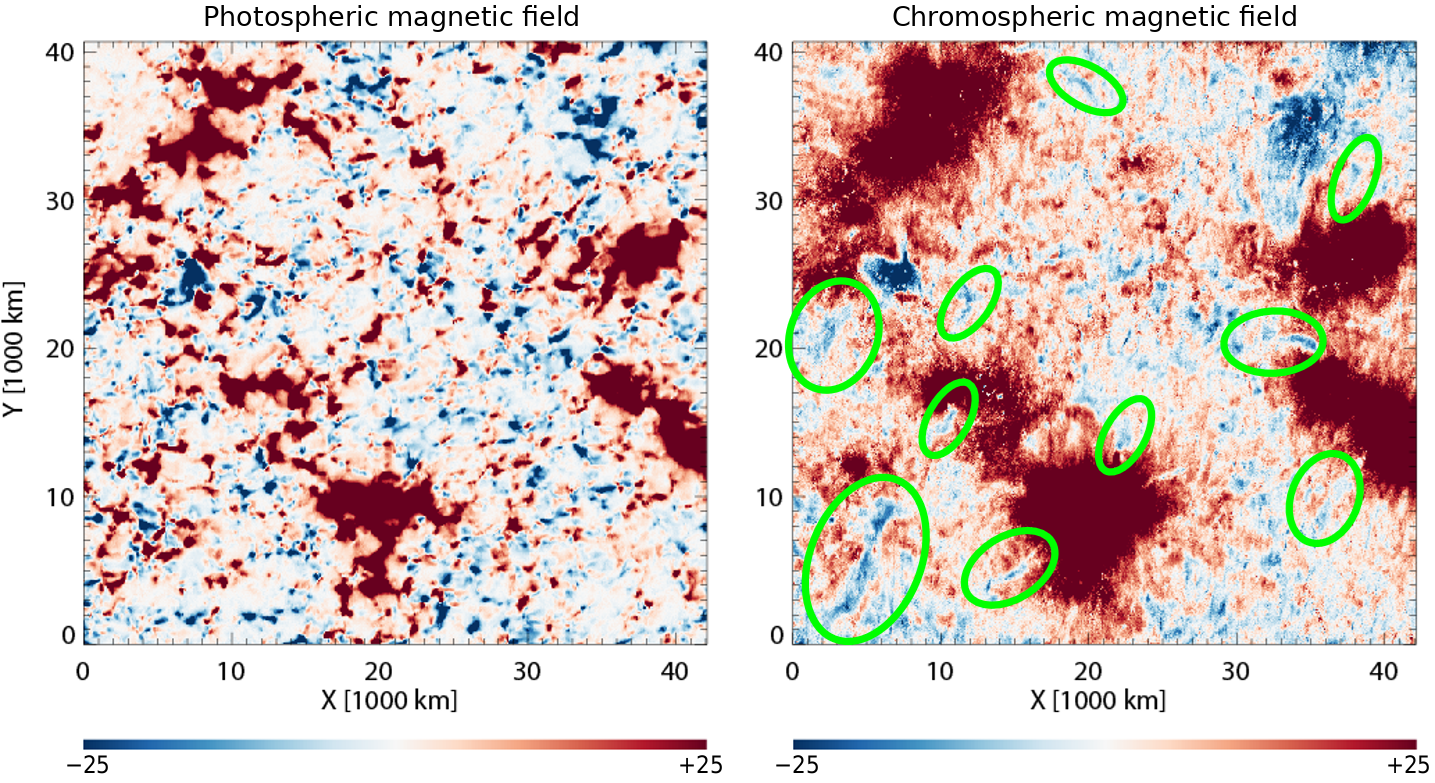
SCIP observations revealed thin, elongated, thread-like magnetic structures embedded within the magnetic canopy above a quiet-Sun region (Figure 1). In particularly clear cases, the magnetic polarity of the threads is opposite to that of the adjacent canopy. The magnetic canopy forms as magnetic fields concentrated at the photosphere spread upward and outward into the chromosphere, creating an arch of magnetic structures. The new observations show that this canopy is not a simple, uniformly expanding structure, but instead contains numerous thin, elongated magnetic substructures.
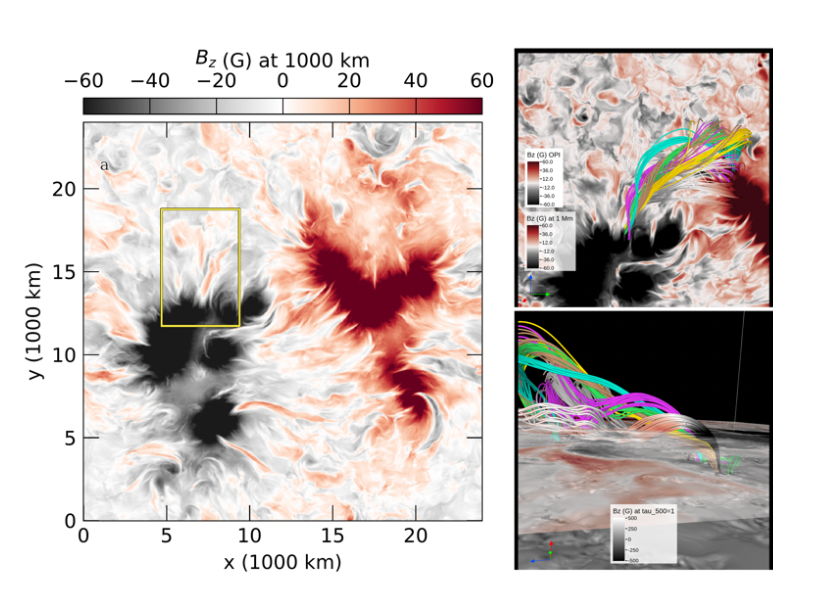
A numerical simulation reproduced the thread-like structures seen by Sunrise-III and showed that they are associated with magnetic field lines twisted by motions at the solar surface (Figure 2). Because these thread-like structures sometimes have a magnetic polarity opposite to that of the surrounding canopy, magnetic reconnection could occur and convert magnetic energy into thermal energy. This discovery provides an important clue toward understanding how the chromosphere and corona are heated.
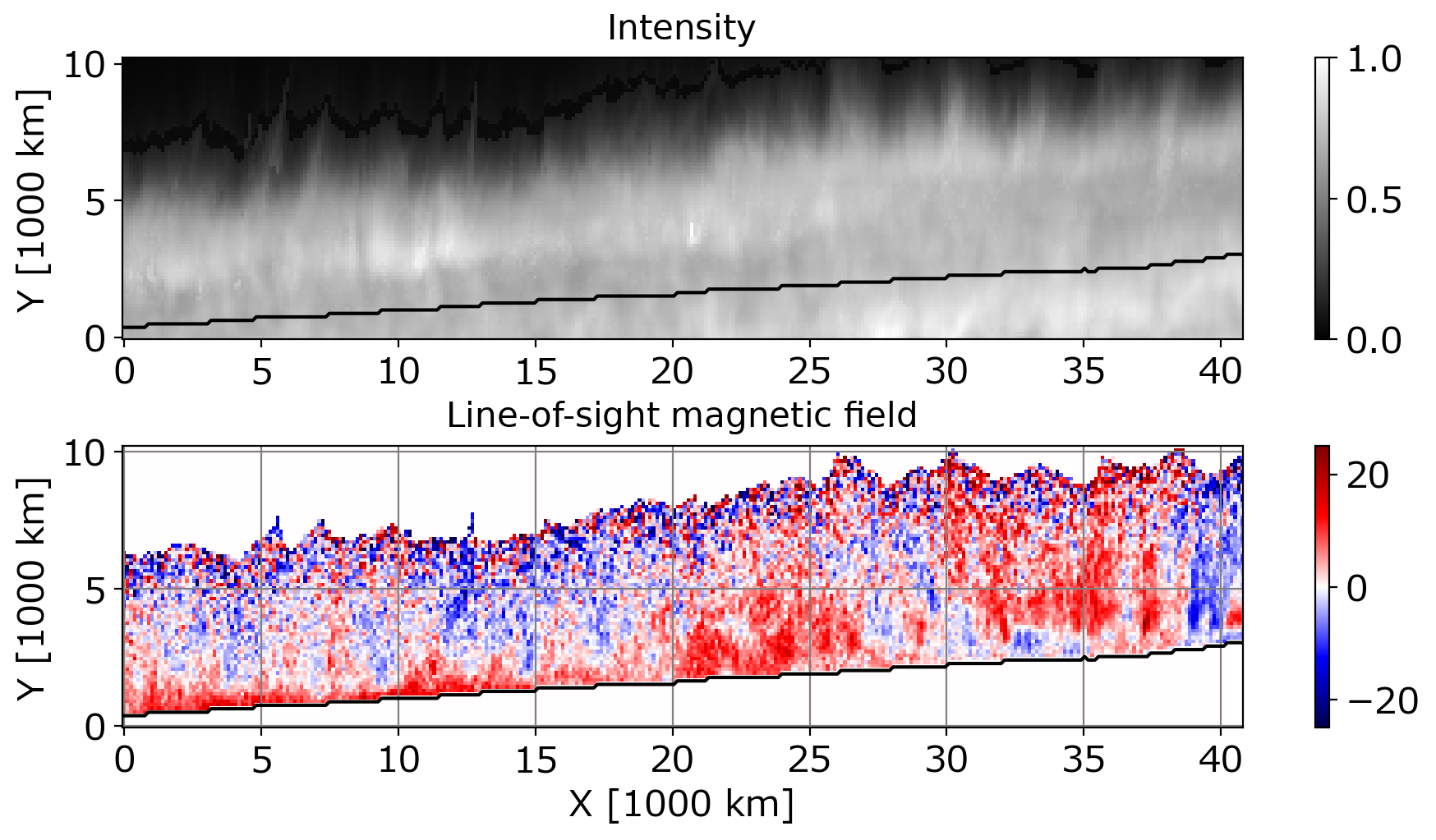
In separate observations of a quiet-Sun region near the solar limb (visible edge of the Sun), SCIP mapped the magnetic fields of spicules, jet-like structures extending upward from the solar surface, and revealed how the distribution of the magnetic field varies with height above the limb. Spicules are thought to carry energy from the solar surface up into the corona. This result opens a new path toward quantitatively evaluating the energy flux transported from the solar surface, through the chromosphere, and into the corona.
These results, together with other initial findings from Sunrise-III, are published in a Focus Issue of The Astrophysical Journal Letters.
【Publication】
THE ASTROPHYSICALJOURNAL LETTERS Sunrise-III Early Sciense
https://iopscience.iop.org/collections/apjl-260303-220_Focus-on-Sunrise-III
- Three-dimensional Magnetic Field Structure of a Quiet-Sun Region Revealed by SUNRISE III/SCIP
Masahito Kubo et al 2026 ApJL 1008 L9
- Magnetic Field Distribution along Spicules Revealed with SUNRISE III/SCIP
Yoshihiro Naito et al 2026 ApJL 1007 L10
- Cause of Chromospheric Opposite Polarity Intrusions Discovered in Sunrise III/SCIP Data: MURaM-ChE Simulations Point to Twisted Flux Ropes
Patrick A. Ondratshcek et al 2026 ApJL 1008 L18
【Funder】
- JSPS 18H05234 Grant-in-Aid for Scientific Research(S) Yukio Katsukawa
- JSPS 23K25916 Grant-in-Aid for Scientific Research(B) Yukio Katsukawa
- JSPS 24K07105 Grant-in-Aid for Scientific Research(C) Masahito Kubo
- ISAS/JAXA Small Mission-of-Opportunity program (Japanese)
【Links】
NAOJ Press Release Stratospheric Observatory Sunrise-III Reveals Intricate Solar Magnetic Structures